De-identified case · second opinion & research
Nico
Infantile-onset Crohn's disease — very-early-onset IBD (VEO-IBD)
Preschool-age boy (Mexico). Symptoms since ~8 months of age. Colonic, stricturing disease with growth failure; refractory to two anti-TNF agents and, to date, without an identified monogenic cause. This page gathers his history in an organized way so specialists can review it and for anyone researching this disease.
- Diagnosis
- Infantile Crohn's · Paris A1a/L2/B2/G1
- Onset
- ~8 months of age
- Data as of
- October 2026
Clinical summary
Timeline
-
~8 months of age
Symptom onset
10 to 15 stools per day with blood and mucus, abdominal pain, night waking and growth arrest. Initially managed as cow's milk protein allergy (extensively hydrolyzed, then elemental formula), without improvement.
-
Jan 2023
First endoscopy — extensive ulcerative colitis
Colonoscopy: extensive ulcerative colitis, UCEIS 7 (Mayo 2), with deep ulcers. Pathology: indeterminate IBD at a very early stage, with eosinophilia; H. pylori and Giardia. Started prednisolone + azathioprine + mesalazine: initial response, but steroid-dependent.
-
Mar 2023
Genetic testing
574-gene panel and, one week later, a 935-gene panel (including skeletal disorders). No monogenic cause; VUS in IL6ST, ARHGEF1, CFB, NLRP1 and others, and one risk allele in ABCG8.
-
Mar–Sep 2023
Rising calprotectin
786 → 954 → 1,000 mg/kg (normal ≤50) on the initial regimen.
-
Sep 2023
First stricture
Follow-up colonoscopy: moderate colitis (UCEIS 4), pseudopolyps and an ascending-colon stricture, still passable. Biopsy with intense activity and up to 50 eosinophils per field.
-
Oct–Nov 2023
Tocilizumab (anti-IL-6)
Three doses (Oct 14, Oct 30, Nov 12), chosen because of a VUS in IL6ST. Partial response; discontinued when an anal fissure and perianal lesion appeared.
-
Jan–Jul 2024
Infliximab (anti-TNF)
Induction from Jan 13, 2024, then every 15 days (12 doses) until Jul 26, 2024. Subcutaneous methotrexate from Apr 2024. No response despite a very high drug level (>50 µg/mL, antibodies 29 AU).
-
May 2024
Active perianal disease
On infliximab: anal stricture, fissure and skin tag; anal dilation under anesthesia. Diagnosis: very-early-onset IBD, probable Crohn's disease. Low IgG (357 mg/dL) and ANA 1:640: referred to immunology for suspected inborn error of immunity.
-
Jul–Aug 2024
Admission to a national pediatric institute (Mexico)
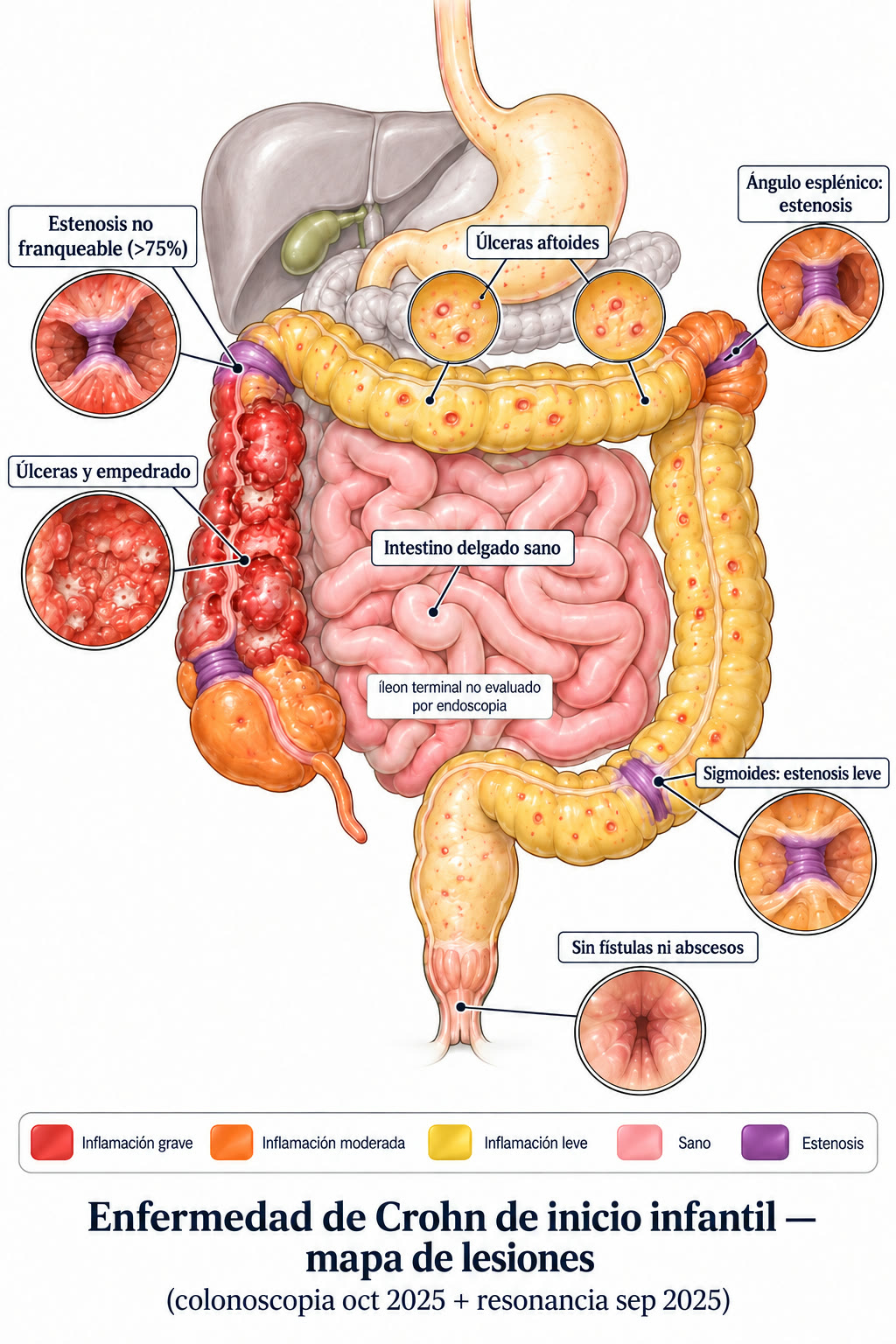
Planned admission under immunology (moderate flare, PUCAI 45). Enteropathogenic/enterotoxigenic E. coli and Campylobacter infection (C. difficile toxins negative). Colonoscopy: infantile-onset Crohn's with severe activity (SES-CD 30) and strictures in the ascending colon, splenic flexure and rectum. Monthly IVIG, cyclosporine and adalimumab started.
-
Aug 2024 – Feb 2026
Adalimumab (anti-TNF)
Every 3 weeks, with methotrexate, cyclosporine and monthly IVIG. Steroid-free from Sep 2024 to Oct 2025.
-
May–Jul 2025
Subclinical activity
Calprotectin 1,980 µg/g (May 2025). Clinically mild; in July adalimumab was reduced and steroids stopped.
-
Sep–Oct 2025
Relapse and non-passable stricture
MR-enterography: active, penetrating disease, no fistulae or perianal disease. Colonoscopy (Oct 2025): SES-CD 20, non-passable ascending-colon stricture (>75% of the lumen). Liver panel normal (ALT 13, GGT <10).
-
Oct–Nov 2025
Hospitalized for C. difficile
C. difficile infection with positive toxin A/B (metronidazole + vancomycin). Steroids resumed. Adalimumab at a therapeutic level (16.2 µg/mL) with no antibodies. Severe malnutrition. DHR and anti-IL-10 antibodies requested.
-
Dec 2025
Anti-TNF failure
Primary non-response to anti-TNF (infliximab and adalimumab, both with adequate drug levels) → candidate for vedolizumab (anti-integrin).
-
Feb–Apr 2026
Vedolizumab (anti-integrin)
Induction at 6 mg/kg: Feb 27, Mar 13 and Apr 10. On Apr 24 increased to 10 mg/kg (maximum dose) every 4 weeks.
-
Jun 2026
New liver injury
Elevated transaminases (ALT 128, GGT 229), active inflammation (ESR 41, leukocytes 16) and iron-deficiency anemia. Liver was normal 8 months earlier.
-
Jun 2026
Treatment reorganization
Vedolizumab paused (last dose Jun 5) and cyclosporine and methotrexate discontinued; slow prednisolone taper (steroid-dependent patient).
-
Jul 2026
Therapeutic rethink
Considering an afimkibart program (anti-TL1A, investigational) and other options (ustekinumab, upadacitinib).
-
Jul 2026
International immunogenetic study
The family (trio) enrolled in a very-early-onset IBD research study. Results pending.
-
Jul 2026
Vedolizumab resumed
At the same maximum dose (10 mg/kg every 4 weeks). Ursodeoxycholic acid added.
-
Aug 2026
Liver normalized
ALT 17, AST 26, GGT 23.8 on active vedolizumab. CRP in range (1.18). Persistent low albumin (2.8), thrombocytosis (553) and microcytic anemia.
-
Sep 2026
Flare of markers at the end of steroids
On prednisolone 1 mg/day (final taper step): CRP 6.5 mg/dL, ESR 51 (corrected 22), albumin 2.3, total protein 5.7, ferritin 5.1, serum iron 12.9. Liver normal.
-
Sep 2026
Steroids increased, methotrexate restarted
Because of the flare, the treating team increased prednisolone from 1 to 10 mg/day and restarted methotrexate, alongside vedolizumab.
-
Oct 2026
Inflammation controlled on high-dose steroids; iron depleted
After ~4 weeks on prednisolone 10 mg/day plus methotrexate: CRP 0.71 and corrected ESR 9 (lowest values of the series). Ferritin 4.4 and hemoglobin 10.7 (iron-deficiency anemia worsening despite oral iron). Platelets 541. Liver normal (ALT 31).
Diagnosis & phenotype
Onset before age 10 (very early / infantile)
Colonic location
Stricturing behavior
Growth failure present
Confirmed by endoscopy + histopathology at a national reference pediatric institute (Mexico). Imaging (MR-enterography): penetrating disease with ulcers, inflammatory-appearing strictures (no fibrofatty proliferation), no fistulae. Perianal disease: anal fissure in 2023 (reason for tocilizumab discontinuation) and an anal stricture with fissure and skin tag in May 2024, already on infliximab, requiring dilation under anesthesia; no longer reported on MR-enterography (Sep 5, 2025).
Treatment
History (discontinued)
| Drug | Class | Status | |
|---|---|---|---|
| Mesalazine + azathioprine | 5-ASA + thiopurine | Discontinued (2023) | Initial regimen (Jan 2023), with prednisolone. Initial response with steroid dependence → biologics. |
| Tocilizumab | anti-IL-6 | Discontinued (Nov 2023) | Three doses (Oct–Nov 2023), chosen because of a VUS in IL6ST. Partial response; anal fissure. |
| Infliximab | anti-TNF | Discontinued (2024) | Jan–Jul 2024, every 15 days. No response with a high level (>50 µg/mL) and antibodies 29 AU; active perianal disease. |
| Adalimumab | anti-TNF | Discontinued (Feb 2026) | Aug 2024 – Feb 2026, every 3 weeks. Primary non-response at a therapeutic level (16.2 µg/mL), no antibodies. |
| Cyclosporine | calcineurin inhibitor | Discontinued (Jun 2026) | Aug 2024 – Jun 2026. Persistently subtherapeutic trough levels. |
Current medications
-
Vedolizumab
Anti-integrin (α4β7) IV. Induction at 6 mg/kg (Feb–Apr 2026); since Apr 2026 maximum dose (10 mg/kg) every 4 weeks. Paused Jun 2026 for transaminases, resumed Jul 2026.
-
Prednisolone
Oral corticosteroid, 10 mg/day since Sep 2026: increased again after the disease flared at 1 mg/day. Steroid-dependent patient.
-
Methotrexate
Subcutaneous immunosuppressant, restarted in Sep 2026 (stopped Jun–Sep 2026 for the liver injury, now resolved).
-
Immunoglobulin (IVIG)
Intravenous immunoglobulin, every 28 days since Jul 2024. Started with low IgG. Ongoing.
-
Ursodeoxycholic acid
Oral, daily. Started Jul 2026 for the liver injury (now normalized).
-
Esomeprazole
Proton-pump inhibitor (gastric protection), daily.
-
Iron
Supplement for iron-deficiency anemia, daily.
-
Folic acid
Supplement (5 mg), twice weekly (Wednesday and Saturday).
-
Vitamin D
Supplement, every 3 days.
Under consideration
- Ustekinumab · anti-IL-12/23
- Afimkibart · anti-TL1A (investigational)
- Upadacitinib · JAK1 inhibitor (oral)
Laboratory studies
Key markers at four time points: before the crisis (Oct–Nov 2025; calprotectin from May 2025), liver peak (Jun 2026), flare at the end of the steroid taper (Sep 2026) and most recent (Oct 2026, back on prednisolone 10 mg/day). The liver remains normal; inflammation came down with the steroid, but iron keeps falling. Albumin was not measured in Oct 2026 (the lab was out of reagent). Fecal calprotectin has never been in range (2023: 786 to 1,000 mg/kg).
| Parameter | Jun 2026 | Sep 2026 | Oct 2026 | ||
|---|---|---|---|---|---|
| ALT | 13 | 128 ↑ | 18 | 31 | ~<40 U/L |
| GGT | <10 | 229 ↑ | 30.9 | 34.4 | 0–55 U/L |
| CRP | — | 1.01 | 6.50 ↑ | 0.71 | 0–2 mg/dL |
| ESR | 16 | 41 ↑ | 51 ↑ | 21 ↑ | 0–20 mm/h |
| ESR (corrected) | — | 28 ↑ | 22 ↑ | 9 | 0–20 mm/h |
| Albumin | — | 3.1 ↓ | 2.3 ↓ | — (not run) | 3.5–4.8 g/dL |
| Hemoglobin | — | 11.1 ↓ | 11.0 ↓ | 10.7 ↓ | 11.5–15 g/dL |
| Platelets | 515 | 589 ↑ | 545 ↑ | 541 ↑ | 150–450 ×10³ |
| Ferritin | — | 8.4 | 5.1 ↓ | 4.4 ↓ | 7–60 µg/L |
| Serum iron | — | 20.8 ↓ | 12.9 ↓ | 14.4 ↓ | 60–170 µg/dL |
| Fecal calprotectin | 1980 ↑ (May) | — | — | — | <50 µg/g |
| IgG (on IVIG) | 1040 | — | — | — | off IVIG, Apr 2024: 357 ↓ |
Genetics
935-gene panel (immunodeficiency + skeletal disorders). No actionable monogenic cause.
Negative (classic VEO-IBD genes)
IL10 · IL10RA · IL10RB · LRBA · CTLA4 · XIAP · FOXP3 · chronic granulomatous disease (CYBB/CYBA/NCF)
Heterozygous VUS
- ARHGEF1
- CFB
- IL6ST
- MMP9
- NLRP1
+ risk allele in ABCG8 (gallstones).
Pending / to discuss: whole-exome or whole-genome sequencing (WES/WGS) + functional immune studies.
Current diet
Usual intake (not exclusive enteral nutrition). Documented as clinical/nutritional context.
- Egg
- Chicken
- Beef
- Rice (gluten-free)
- Gluten-free spaghetti
- Corn tortilla
- Potato
- Chayote
- Beans
- Lentils
- Avocado
- Apple
- Banana
- Bolillo (wheat roll)
- Biscuits (local brand)
Open questions for specialists
- 01 With vedolizumab already at maximum dose and shortened interval, inflammation returns as steroids are withdrawn: what is the next maintenance option: anti-IL-12/23 (ustekinumab), anti-TL1A (afimkibart) or JAK (upadacitinib)? How to cover the transition?
- 02 Exclusive enteral nutrition as a bridge to induce remission and restore albumin (2.3 g/dL) instead of prolonging steroids?
- 03 Given infantile onset and a negative panel, is whole-exome/genome + functional immune studies warranted? The IL6ST VUS already prompted a tocilizumab trial (partial response); relevance of ARHGEF1?
- 04 The 2026 liver injury normalized on active vedolizumab: does that point to methotrexate/cyclosporine or to the disease itself?
- 05 On monthly IVIG since Jul 2024 (prior IgG 357 mg/dL, low). For how long, and how to re-evaluate his own antibody production? DHR and anti-IL-10 antibodies were requested (Nov 2025).
- 06 Non-passable right-colon stricture: inflammatory or fibrotic? Threshold for dilation/surgery?
- 07 Experience with similar cases or pathways into VEO-IBD registries (e.g. NEOPICS, VEO-IBD Consortium)?
Are you a specialist or researcher who can help?
Any guidance, experience with similar cases, or study pathways are welcome.
Contact: arguetagra15@gmail.com